
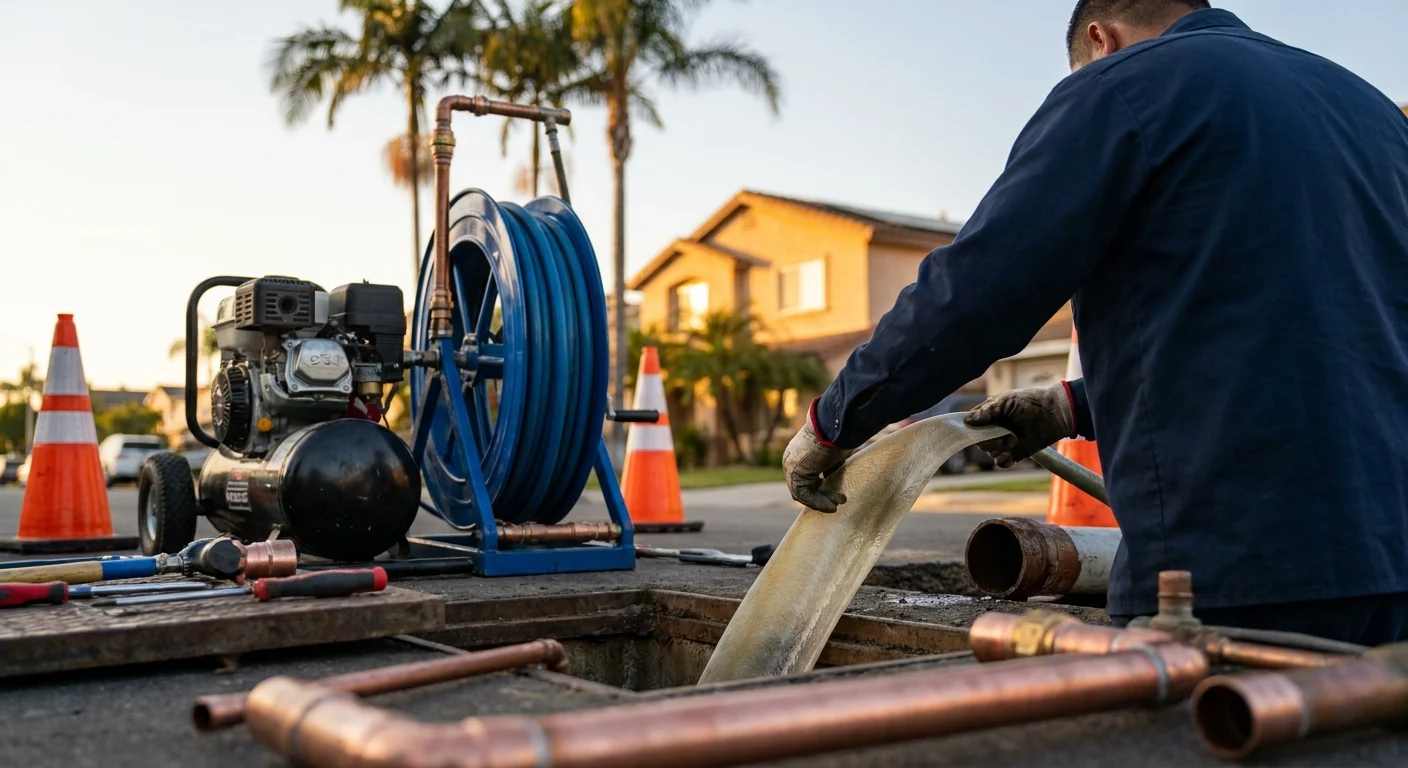
Twenty-five years ago, every sewer repair in Los Angeles meant a backhoe in the yard. If the damaged pipe ran under your driveway, you paid extra to break up concrete and re-pour. If it ran under a 50-year-old oak, the tree often didn't survive. If it ran through your rose garden, the garden didn't come back.
Today, trenchless methods can handle 80% of LA residential sewer repairs with no trenching between access pits. The technology has matured, costs have come down, and city permit departments are used to seeing it. Here's how it actually works and when to choose it.
The Two Methods
CIPP (Cured-in-Place Pipe) Lining
An epoxy-saturated felt liner is pulled through the existing pipe, inflated with compressed air, and cured in place using heat or ambient cure. The result: a new, seamless pipe-within-a-pipe with a 50-year rated life. The old pipe becomes the formwork for the new one.
Best for: Cracked but still-intact lines, multiple offset joints, root-intrusion joints. Pipes that retain enough structural integrity to hold the liner during inflation.
Pipe Bursting
A bursting head pulls new HDPE (high-density polyethylene) pipe through the existing pipe's path while fragmenting the old pipe outward into the surrounding soil. The result: a new, larger-diameter pipe on the original alignment.
Best for: Collapsed or Orangeburg pipes that can't be lined, situations where you want to upsize the line from 3" to 4", or heavily root-invaded lines where lining would be complicated.
What Happens on Installation Day
CIPP Lining (typical single-day job)
- Morning: Dig two small access pits (roughly 4' x 4' each) — one at the cleanout, one near the city main tap.
- Hydro jet the existing line clean of grease, sediment, and root mass.
- Re-camera to confirm a good host pipe surface.
- Saturate the felt liner with two-part epoxy resin in a truck-mounted mixer.
- Invert the liner into the existing pipe using compressed air — the epoxy side ends up bonded to the interior pipe wall.
- Inflate and cure — typically 2–4 hours with ambient cure.
- Reinstate lateral branches — a robotic cutter opens up any tees or wyes that were lined over.
- Post-camera to verify the cure.
- Backfill, close access pits, restore surface.
Pipe Bursting (typical 2-day job)
- Day 1: Two larger access pits (roughly 6' x 6'). Rig a hydraulic pulling unit at the downstream end.
- Attach the bursting head to new HDPE pipe.
- Pull the bursting head through the existing line — takes 30–90 minutes for a typical residential lateral. The new pipe feeds into the void behind.
- Day 2: Make the new connections at both ends, pressure-test, re-inspection, restore access pits.
What It Costs in LA
| Method | Typical cost per linear foot | Full-lateral (60-80 ft) typical |
|---|---|---|
| CIPP Lining | $125–$200 | $8,500–$14,500 |
| Pipe Bursting | $150–$275 | $11,000–$19,000 |
| Traditional open-cut | $90–$175 (+ restoration) | $7,000–$14,000 (+ landscape/hardscape) |
The trenchless premium is real — typically 20–40% more per foot than open-cut. What you save: landscape restoration, driveway re-pour, mature tree replacement. For lines running under anything substantial, trenchless usually wins on total cost once restoration is factored in.
When Trenchless Is the Wrong Choice
- Severe bellies (sags). A liner or bursting head won't fix a low spot in the line — it just creates a lined low spot. You need to excavate, re-set the pipe at proper slope, and only then consider lining.
- Total collapse of long sections. Lining needs a host pipe to form against. A fully collapsed section can't support the liner.
- Non-circular or noticeably deformed host pipe. Liner geometry assumes a round pipe. Deformed clay or cast iron sometimes can't be lined safely.
- Very short repairs. A 6-foot spot repair via open-cut costs $3,000. A CIPP liner for the same length costs $4,500. When you don't need a full lateral repair, open-cut spot work wins on price.
Permits and Paperwork
Every LA jurisdiction requires a permit for sewer work, trenchless included. That means:
- Permit application and fee (typically $300–$650).
- Inspection at key stages (usually after access pits are dug and before trenchless work starts).
- Final inspection and sign-off card.
Reputable trenchless contractors pull the permit as part of the job. If a quote is suspiciously cheap and doesn't mention permits, that's a red flag — skipping the permit saves a few hundred dollars now and creates problems at resale.
Schedule an LA trenchless sewer consult
Plumbing Geeks is C-36 licensed, family-owned, and dispatches 24/7 with no overtime charges. We serve Los Angeles and the rest of the San Fernando Valley and Greater LA from our Sun Valley base.